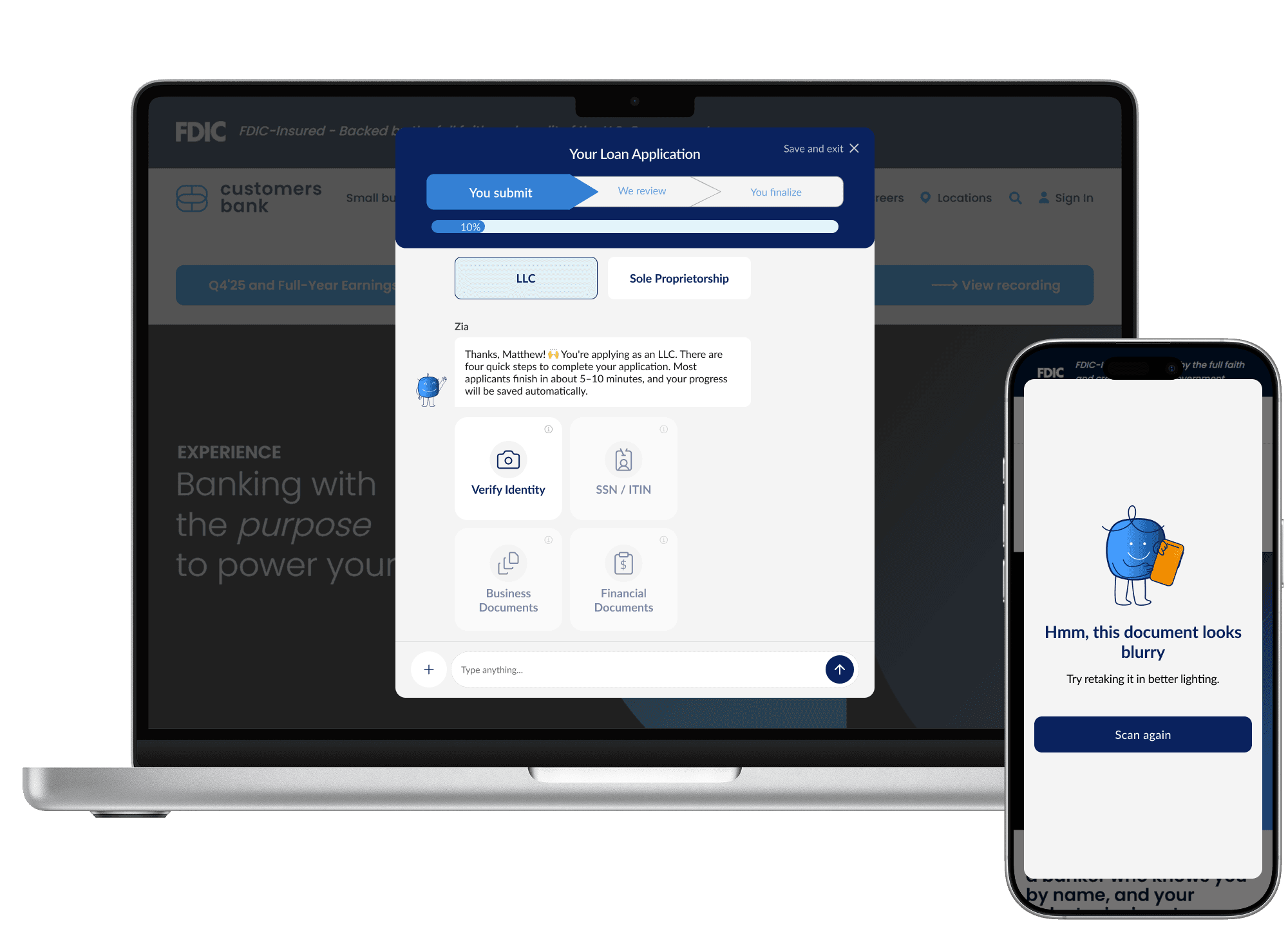

Designing a faster, fraud-screened loan intake experience
Industry
Fintech
Headquarters
San Francisco, CA
My Role
Product Designer
Skills Utilized
AI Interaction Design
Systems Thinking
End-to-End UX
Workflow Simplification
What is ZorroFi?
ZorroFi is a white-label platform that helps banks collect and verify loan applications before underwriting. ZorroFi's platform ensures applications are complete, accurate, and screened for fraud.
My Role:
I worked directly with the co-founder to design a mobile onboarding experience that guides small business applicants through submitting their loan documents.
Designed an AI-guided chat experience (“Zia”) for step-by-step submission
Focused on reducing friction for applicants while improving data quality for lenders
Balanced user experience with backend validation and fraud detection needs
Challenge
Design a loan application experience that:
Reduces drop-off caused by confusion and unclear requirements
Improves application quality for lenders
Works within existing banking systems (no major tech changes)
This meant designing for two sides at once:
Applicants who need clarity and guidance
Lenders who need complete, reliable data
Solution
An AI-guided onboarding experience that walks applicants through structured loan submission.
Step-by-step guidance through required documents
Real-time feedback on issues (e.g. blurry or missing files)
Clear progress tracking throughout the process
Result:
A more intuitive experience for applicants, and cleaner, more complete applications for lenders before underwriting even begins.
Final Design
01
Problem
Borrower Problem
Loan applications are complex and confusing.
Applicants don’t always know what documents are required.
Missing or incorrect submissions lead to repeated requests.
This creates frustration and increases drop-off rates.
Lender Problem
Loan officers spend significant time chasing missing or incorrect documents.
Applications arrive incomplete or inconsistent.
Fraud detection often happens too late in the process.
There is limited visibility into where applicants are getting stuck.
Loan intake is currently fragmented—borrowers struggle through unclear requirements, while lenders lack structured, verified data to make timely decisions.
Key Design Challenge:
“How might we guide applicants through a complex loan submission process in a way that reduces drop-off for borrowers while delivering clean, fraud-validated applications to lenders?”
Constraints:
The solution:
Must integrate into existing bank systems.
White-label product (adaptable UI for each bank).
Must serve both borrower + lender (bank) needs.
Must support early fraud detection without adding friction.
02
Process
2A — Understanding the System
I began by mapping the end-to-end loan intake journey to understand how applications move from submission to underwriting across both user and operational layers.
This revealed a dual-layer system:
The borrower-facing experience, where users submit personal and business documentation through a guided flow
The backend validation system, where documents are reviewed for completeness, accuracy, and fraud signals before underwriting
From this, I defined two parallel progress structures:
The overall loan lifecycle: Submit → Review → Finalize
The granular submission flow: step-by-step document collection and validation
Insight:
The core challenge wasn’t simply onboarding users—it was designing alignment between two systems with competing priorities: speed and simplicity for borrowers, and accuracy, completeness, and fraud prevention for lenders.
This system definition became the foundation for both the onboarding experience and the progress tracking model.
Design Decisions That Shaped the Experience
To guide the interaction model, I made several key design decisions based on the system requirements:
Chat-based onboarding instead of form-based intake
→ reduces cognitive load and allows users to complete complex steps through guided interactionDual progress system instead of a single progress bar
→ ensures users understand both overall loan status and immediate task completionReal-time validation feedback instead of post-submission review
→ prevents errors from compounding and reduces rework for both users and lendersStructured document stages instead of open file uploads
→ creates clarity around expectations and improves data consistency for underwriting
These decisions directly informed the structure of the onboarding flow and the design of the Zia interaction model.
2B — Designing the Guided Experience
2C — Progress and Clarity System
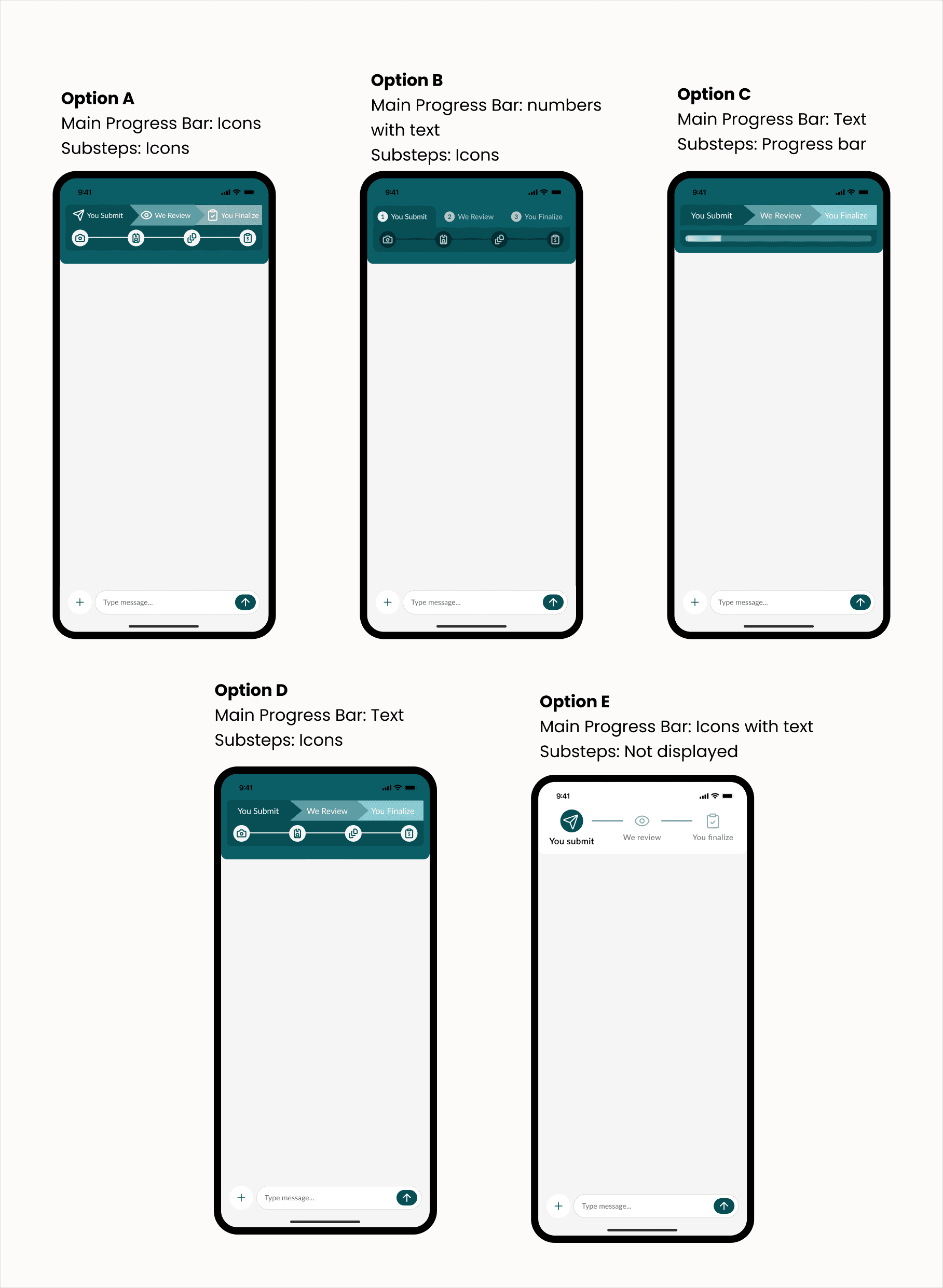
I designed a dual-layer progress system to address one of the main failure points in loan applications: loss of context during multi-step processes.
The experience included:
A high-level journey indicator showing overall loan status: Submit → Review → Finalize
A step-level progress tracker showing completion of individual document requirements
Together, these created continuous clarity across both the macro journey and micro tasks.
This ensured users always understood:
Where they are in the process
What is required next
What has already been completed
Why it matters:
Loan applications often break down when users lose visibility into progress or next steps. This system was designed to maintain momentum, reduce uncertainty, and prevent drop-off in long, multi-step submission flows.
03
Solution
A structured, AI-guided onboarding experience for loan intake
I designed a structured, AI-guided onboarding experience that streamlines loan intake for applicants while ensuring lenders receive complete, verified, and fraud-checked applications.
The experience includes:
An AI-led onboarding chat interface (“Zia”) that guides users through the application process
A step-based document submission flow broken into clear stages of identity, business, and financial verification
Real-time feedback on document quality, including detection of blur, mismatches, and missing information
Contextual prompts that guide users in submitting the correct loan documentation
A dual progress tracking system showing both overall loan journey and step-level completion
A white-label design system adaptable to individual bank branding and requirements
Together, these components create a guided intake experience that reduces user drop-off while improving the quality and completeness of applications entering the underwriting pipeline.
04
Outcomes
Product & Design Outcomes
The ZorroFi onboarding experience established a guided loan intake experience:
Reduced ambiguity in document submission through real-time guidance.
Improved clarity across multi-step loan application processes.
Enabled lenders to receive more complete, organized, and fraud-screened applications earlier in the pipeline.
Created a scalable foundation for white-label deployment across financial institutions.
Traction & Validation
Beyond the design work, the product gained strong early momentum and external validation:
Accepted into Berkeley’s PAD-13 startup accelerator, validating early product direction and market relevance
Accepted into SkyDeck (UC Berkeley’s funded startup accelerator) — a highly competitive program with ~1% acceptance rate
Signed contracts and agreements with multiple banks, securing early customers based on the prototype and product vision
Progressed from concept → working prototype → real institutional adoption in a regulated financial environment
04
Reflection
What Worked Well
Working on ZorroFi reinforced how much of UX in financial systems is about reducing uncertainty across multiple stakeholders. The challenge wasn’t just improving usability—it was designing clarity into a process that traditionally depends on manual intervention and fragmented communication.
“This project reinforced how much of UX in regulated systems is about reducing uncertainty across multiple stakeholders—not just improving interface usability.”
This work demonstrated how early-stage UX design can directly influence product credibility and business traction—especially in complex, high-trust domains like lending infrastructure.
Learnings
???